
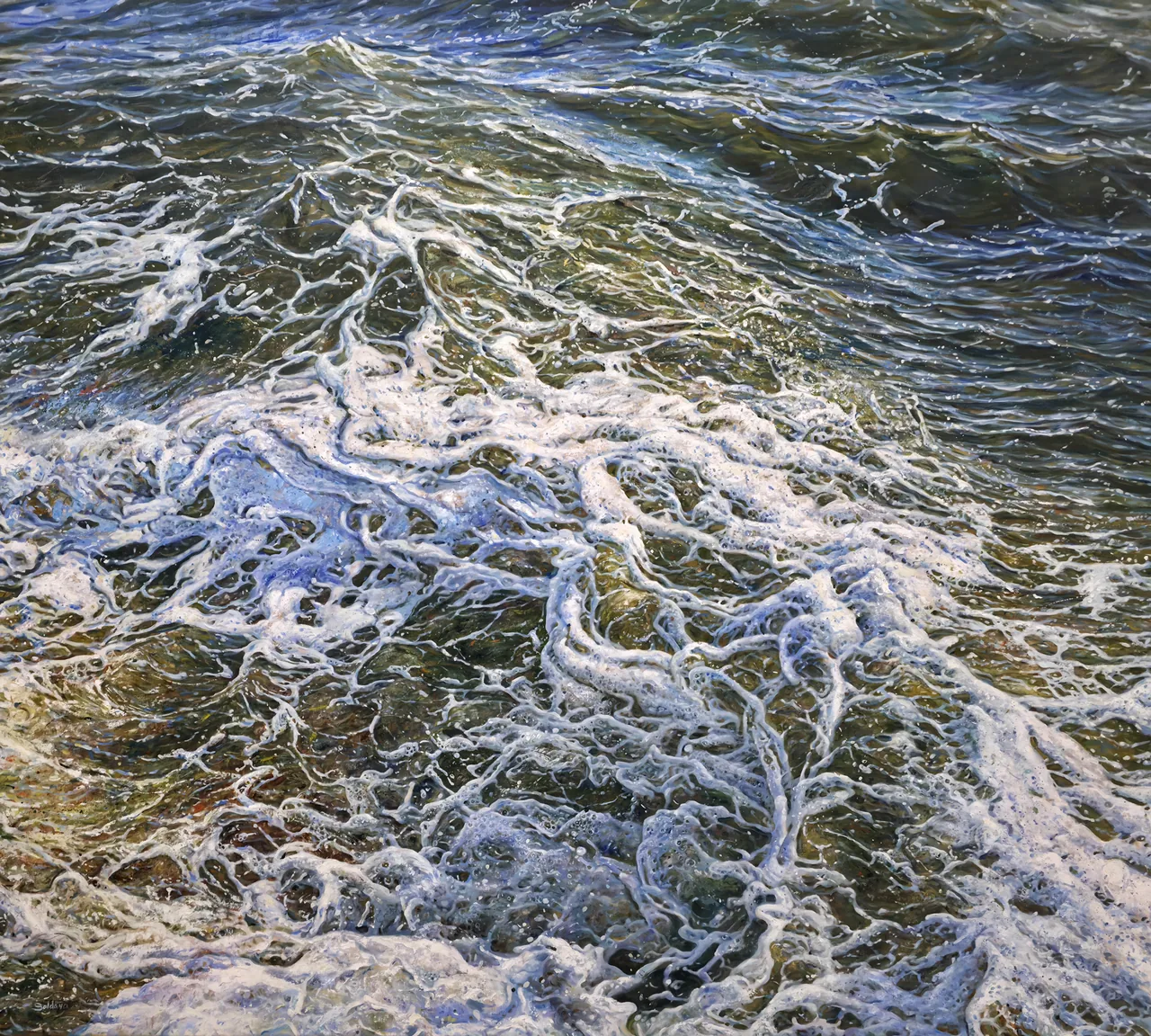
Anatomy
The Anatomy series explores water as a living body, revealing structures, folds, transparencies and forms that evoke an organic anatomy: waves, foam, currents, textures and liquid formations.
Through a close, photorealistic approach, each liquid surface becomes a territory of perception, where nature takes on an almost corporeal dimension. The series reflects on fragility, movement and identity, understanding water as an ever-changing organism.
Critical text · Pedro E. Rizo Peña, 2020
Reflejos Exhibition
Reflejos (Reflections) was the title under which works now part of Anatomy were shown in 2020.
Water, its surface and that matchless reflective quality will always be a source of inspiration for artists. This capacity to see ourselves and objects from another perspective will always be a magnet, for the sensations it stirs beyond the sensory and, more deeply, in the perceptual. Luis Alberto Saldaña Soto ventures to look at himself in that “mirror”, trying to unravel the meaning of the images that water gives back to us through reflections… not only the physical reflection, but that multiplicity of realities which the surface of that medium returns to us along its paths of light.
I dare to suggest that Saldaña is bewitched by the illusory figures he comes upon in each watery mirror. Some of the images border on the surreal; others give back a landscape impossible to place; there are those that evoke religious icons such as Our Lady of Charity of El Cobre; and the everyday life of Cubans, with their bicycles and their fishing boats, is present too.
This series in particular, within the artist’s work, is captivating… Used as he is to the hyperrealism he usually paints, the works on reflections reach a subconscious level in the practice of this young painter from beyond the city. It is perhaps an artistic re-creation of the myth of Narcissus, in which the artist transfers to objects that need for personal self-discovery. But unlike that ancient tale, Alberto finds in the reflection of reality – at times distorted by the movement of the ripples on the water – a new world, and not the mere vain representation of things. A new narrative, parallel to the space that artists have traditionally brought to their canvases.
The pieces shown on this occasion open a gaze onto that unknown dimension – I have already said it is a window onto the subconscious – hidden and remote, which not only the artist but all of us who approach the canvases possess. These reflections are that window onto an unreal, almost impossible space. The two polyptychs on show are an example: they strike us as landscapes of riverbanks, yet the distortion of the image leads us away from the traditional forms of landscape painting, as well as from the colours that usually accompany such representations; academic balance is broken and a whole range of opportunities for expression opens up. Reflecting water, then, becomes a new character in Luis Alberto’s pieces.
Something strikes us again and again in this exhibition – far from the city and housed in a gallery outside the recognised circuits: the absence of limits in each work, thanks to the sense of freedom that always accompanies water, as well as the presence of images that are not directly in the scene… A kind of magical realism. There is no direct relationship between observer and object, and without meaning to, we become, alongside the artist, one more reflection in these paintings, like troubled mirrors of water.
Pedro E. Rizo Peña · 2020 · On the Reflejos exhibition, Casona Sur Gallery, Melena del Sur · Translated from the Spanish · source
Critical text · Yosnel Salgueiro, 2020
On the Reflejos Series
Reflejos (Reflections) was the title under which works now part of Anatomy were shown in 2020.
The mysterious spiral of the seashell treasures the whisper of the sea within it. Listening to it soothes the spirit. An interesting theory suggests that this happens because, from the embryonic stage onwards, we are in contact with the rhythmic ebb and flow of the mother’s amniotic fluid. Our relationship with this very special sea is thus universal, basic and primordial.
Existence, born of the sweating dance of bodies, is a fusion and confluence of vital fluids, swells of brine and murmuring breath. In an inner, protective sea the breath takes shape until it rises to the surface in a gulp of oxygen after the traumatic breaking of the waters. Once the equidistant balance of the waters is shattered, the battle begins.
The birth of the work (the being) must be baptised. The name takes on the utmost importance; it becomes a signifier as it defines, identifies and traces the paths of the work’s future hermeneutics.
Luis A. Saldaña (Güines, 1987) has called the works in this exhibition Reflejos. Put simply, we can conceptualise the word as the property inherent in matter of leaving traces (physical or mental) in time and space. A tiny ant, crossing the dust, leaves behind the ephemeral reflection of its passing. Matter (organic or inorganic) bears witness to its presence in the fruits of its interaction. Of all reflections, the most elaborate is consciousness: the subjective reflection of objective reality.
Island subjectivity, furrowed by the waters, has many ways of relating to the sea: the Piñerian one of the damned circumstance; another of joy, festive and cheerful, which we shall call Dionysian; and a meditative, relaxing and transformative one, or Aristotelian. Each of these visions, and all of them together, in a unity and struggle of opposites, strive and wrestle to prevail, without thereby managing to escape the perennial embrace of the waters against the waters, now measured and rhythmic, now in terrible abandon.
Saldaña, whose earlier pictorial poetics drew on a more figurative visual language of strong, well-defined and contrasting lines, now takes up the risky challenge of the fluidity of liquid, of exhilarating silk, of representing the waters with their dynamic charge, their chromatic turbulence, their sounds and smells that cannot be caught. The result: a successful transition, a novel rupture, an evolutionary and harmonious leap of faith – admittedly, and of necessity, still unfinished – but a laudable one towards abstraction, which is the realm of indefinite form and the emotional empire of colour well used.
In Saldaña’s paintings we discover the meeting of cold and warm waters, calm and choppy, rising and falling, captured forever by the painter’s meticulous hand. Religiosity, an inseparable part of the syncretic soul that distinguishes us, is not left out of the artist’s conceptual discourse; and were he not to set it down tacitly, we would have to bring it in by implication.
The sea brings with it life and death, union and separation, joy and sorrow, peace and desolation. More than dual or ambivalent, it is plural and diverse. Narcissus could contemplate himself for hours in the calm waters of the spring or the lake, but never in the salty domain of Yemayá. If Heraclitus reminds us that no one can bathe twice in the same river, Saldaña seems to tell us, through his strokes and palette-knife work, that still less can we do so in the kinetic, ever-changing waters of the sea. They are our reflection.
Yosnel Salgueiro · 2020 · Translated from the Spanish · source
Oil on canvas · 120 × 200 cm (47 × 79 in)
Oil on canvas · 32 × 38 cm each (12.5 × 15 in each)
Oil on canvas · 68 × 76 cm (27 × 30 in)
Available
Oil on canvas · 56 × 51 cm (22 × 20 in)
Available
Oil on canvas · 32 × 38 cm each (12.6 × 15 in each)
Oil on canvas · 130 × 150 cm (51 × 59 in)
Oil on canvas · 150 × 200 cm (59 × 79 in)
Oil on canvas · 150 × 200 cm (59 × 79 in)
Oil on canvas · 90 × 60 cm (35 × 24 in)
Oil on canvas · 170 × 114 cm (67 × 45 in)
Oil on canvas, diptych · 100 × 100 cm each (40 × 40 in each)
Oil on canvas · 150 × 450 cm (59 × 177 in)
Oil on canvas · 130 × 170 cm (51 × 67 in)
Oil on canvas · 150 × 200 cm (59 × 79 in)
Oil on canvas · 100 × 130 cm (40 × 51 in)
Oil on canvas · 100 × 130 cm (40 × 51 in)
Oil on canvas · 170 × 190 cm (67 × 75 in)
Available
Oil on canvas · 130 × 150 cm (51 × 59 in)
Oil on canvas · 170 × 114 cm (67 × 45 in)
Oil on canvas · 130 × 150 cm (51 × 59 in)
Available
Oil on canvas · 100 × 76 cm (40 × 30 in)
Oil on canvas · 152 × 180 cm (60 × 70 in)
Oil on canvas · 120 × 91 cm (47 × 36 in)
Oil on canvas · 120 × 200 cm (47 × 79 in)
Oil on canvas · 150 × 200 cm (59 × 79 in)
Oil on canvas · 150 × 325 cm (59 × 128 in)
Oil on canvas · 150 × 200 cm (59 × 79 in)
Oil on canvas · 100 × 150 cm (40 × 59 in)
Oil on canvas · 150 × 200 cm (59 × 79 in)
Oil on canvas · 150 × 225 cm (59 × 88.5 in)
Oil on canvas · 122 × 170 cm (48 × 67 in)
Available
Oil on canvas · 102 × 76 cm (40 × 30 in)
Available
Oil on canvas · 61 × 61 cm (24 × 24 in)
Available
Oil on canvas · 120 × 170 cm (47.2 × 66.9 in)
Oil on canvas · 50 × 50 cm (19.7 × 19.7 in)
Oil on canvas · 50 × 50 cm (19.7 × 19.7 in)
Oil on canvas · 32 × 38 cm (12.6 × 15 in)
Oil on canvas · 44 × 53 cm (17.5 × 21 in)
Oil on canvas · 35 × 50 cm (13.8 × 19.7 in)
Oil on canvas · 50 × 50 cm (19.7 × 19.7 in)
Oil on canvas · 50 × 50 cm (19.7 × 19.7 in)
Oil on canvas · 40 × 60 cm (15.7 × 23.6 in)
Oil on canvas · 50 × 50 cm (19.7 × 19.7 in)
Oil on canvas · 32 × 38 cm (12.6 × 15 in)