
Of Seas and Homecomings
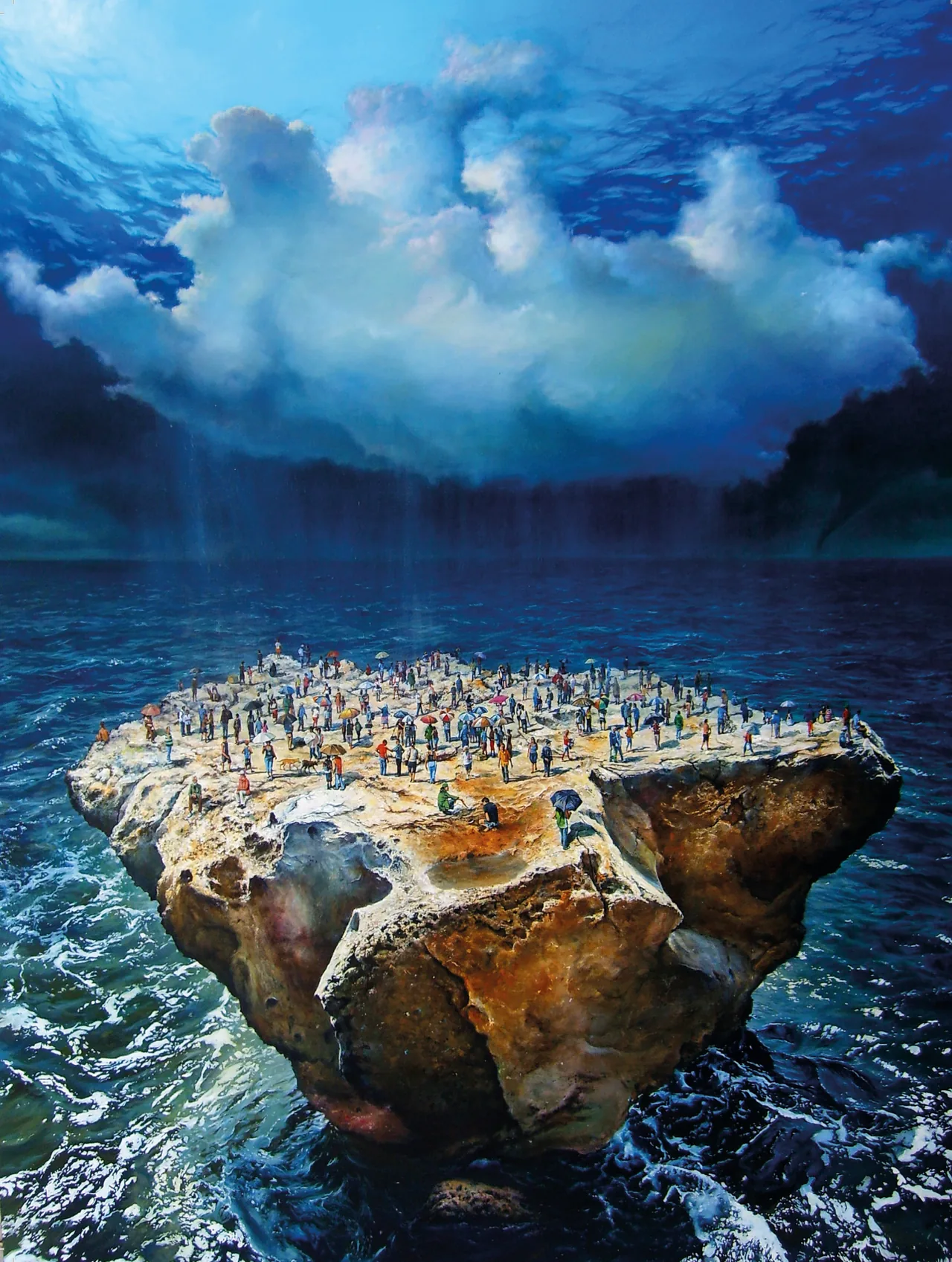
The moment the sea takes over Saldaña's work. In translucent blues, human figures and objects float and wait on the water: the uncertainty, loneliness and fear of departures and returns. In La espera heredada, a people waits on a crag in the open sea; Píter Ortega sees in it “a sorrowful and magnificent vision of arrested time”. The series was shown at the ICAIC “Fresa y Chocolate” Cultural Center in Havana in 2015.
Critical text · José Luis González-Almeida
Airs of a Gaze Not at All Sombre
“I will caress the air and smile at the shadow, in case in the shadow you are watching me and in the air you kiss me.”
Dulce María Loynaz
Caresses that slip away, pale libidos, defenceless pupils… As if from some most ancient spell, almost by mimesis, converted ice floes spring forth in bodies swollen with blushes, possessed by the mist. Their goal is restraint, prudery in heat; their star, the shadow. They are bounds, bridles for a modern skin, one already averse to confinement; skin-light, skin-foliage where a sleepless enthusiasm – consubstantial with our true essence – rehearses / premieres its gladiatorial gifts, bent on becoming a hymn of praise to perpetuation, an inheritance for the rose.
Much that is a vital sign, much of refinement and lust brought together – that is to say: dissolved, in league – lies beneath each of our actions. Everything depends on which of these empires we grant supremacy, on the shade we pour over one fragrance or the other… And those who argue that whatever is reserved for them is mere circumstantial ruse will not be without reason: both, then, prefigure burins of identical silverwork, instances of complement. I do not allude – or at least not exclusively – to a refinement and a lust confined in and for the sensual / sexual, but to behavioural choices that, in fair fight, undermine the human plural, capable of mining any path of anthropic existence.
Perhaps that is why Luis Alberto Saldaña Soto (Güines, 1987) does not founder among the two, the twenty thousand, the infinite waters he circumnavigates. So robust is his conviction regarding these axioms (and so functional his logbook) that he scarcely leaves us room for stasis, for the fossilisation of ideologemes. Like few in his field – all the more so in times marked by worldwide derision and banality – he knows how to dock in a safe harbour: across each of his canvases sails a kind of symbolic majesty that does not falter before the challenge – I correct myself: before the arcanum – of the spiritual mare magnum with which we preface our trifles and complexities. Hence: his is a pictorial work of and for reflection, the sacrament of a (meta)conceptual orgasm sheltered in a whole splendour (a symphony?) of technique, recurrent, like it or not, when it comes to sounding the mystical annunciations that halo the human being in the no less realist endeavour of shaping the cartography of his destiny; an orgasm / splendour recurrent, like it or not, when it comes to arraying our works in the Nietzschean insolence of being “beyond good and evil”. What other argument could sustain that gust of Polyphemic eyes, belligerently omniscient, which, in the manner of Michel Foucault, (per)jure never to stop watching us so as, from that very psychopathology, to punish us with stubbornness and spite?
Saldaña recreates an imaginary determined to strip us bare before the most lascivious – because most biting – of mirrors. There they are, mocking our airs and our resentments, our fears and utopias, those presences (creatures and objects, subplots and atmospheres) as grotesquely public as they are nihilistically solitary (intimate), which come only to revisit the constant pain, the perennial iconoclasm that besieges us; there, that – why not? – anatomical texture of the igneous-rocky, deeply committed to the introspection not only of the physical-corporeal but of a sociocultural environment not always a provider of enthusiasms and reveries; there, finally, the sea, a genre of negation that affirms, a sadistic via crucis for departures / returns, a space which, though barred to the necessary elongations of earthly plenitude, stands ever ready to transvest the obstinacy (the quia nominor leo) of a dominating other into the most crackling of chimeras.
The cry, the retort that Luisito hurls with the brazenness of a genuine artist, does not make its mark eternal from the ephemeral immanence of chaos and hysteria. Quite the contrary: the vapour of those – impaled? – tongues that his paintings secrete corrodes, with an entomologist’s expertise, each of the shackles present in the aberration of silences. Appreciating, then, the verisimilitude of his scenes, reading his annals and chronicles – he is a potential writer with palette and brush – the most profane of spectators or the most erudite professor of art may no longer merely inquire into the intellectual semantics of a mythopoetics that would let them touch the springs of pictographic perfection, but rather come to grasp how the energising amniotic element of our most secret yearnings becomes a metaphorical echo of the genesis and end of all life, the alpha and omega of an existence at once torn and eloquent, capable of caressing the ever-luminous gaze of a kiss.
José Luis González-Almeida · Translated from the Spanish · source
Critical text · Píter Ortega
Those Who Dwell on the Stone
On a crag suspended in immensity, surrounded by a sea that promises neither salvation nor shipwreck, a people waits. Luis Alberto Saldaña Soto's painting “La espera heredada” (The Inherited Wait), oil on canvas, gives us a grieving and magnificent vision of time standing still, of a humanity huddled together on the certainty of uncertainty.
The stone that holds these men and women is not a continent, not a homeland, not a home. It is a remnant, a residue, a fragment torn from the land or from a shipwreck, a place too small for so much life, yet the only one where one can still remain. Its roughness is the fossilised memory of what is no longer there. The artist has modelled it with an almost tactile truthfulness, in warm tones that clash with the coldness of the surrounding water, as if he wished to remind us that what is most human still holds out against the open elements.
Above, a thick, round, powerful cloud hangs like a threat and a promise. It does not rain on the sea. Only on them. As if the universe were singling them out, punishing them, or perhaps blessing them. That rain, intimate and aimed, seems to bring more weight than relief. Is it water? Or is it time falling in liquid form? Is it the past that never stops falling on the heads of those who inherit the wait? Each drop is an echo of broken promises, of departures without return, of postponed futures.
And meanwhile, they. The tiny figures, rendered with almost obsessive detail, gather as in an exodus without a destination. Some with umbrellas, others alone. Some moving, others still. But all under the same sky, on the same stone, surrounded by the same sea. There are no leaders. There is no way out. Only a choreography of resistance. There is no conflict among them: they are together, not because they understand one another, but because there is nowhere else.
Waiting, here, is not only an action but an ontological condition. A way of being. These beings are not killing time. They are time. They are generations who inherited patience the way one inherits land, fear, faith. They are not waiting for a ship, nor for a god, nor for an immediate redemption. They wait because they were born on a stone and were taught that one day something would come — a country, a miracle, an answer. This is the wait handed down like a dead language, like a cultural DNA: the inherited wait.
The sea is the infinite that does not welcome. There is no visible coast, no horizon to inspire. Only that intense blue Saldaña has managed to build with superimposed layers of oil, creating a hypnotic, abysmal depth. It is not Ulysses' sea, nor the sea that leads to Ithaca. It is the sea as limit, as border, as a cruel mirror that reflects our smallness.
The sky, for its part, neither opens nor closes. It is a suspended theatre where the divine no longer acts, only watches. Saldaña has achieved an emotional chiaroscuro: the upper part is luminous, almost heavenly, while below the world is density, water and stone. There is a visual tension that forces us to choose where to rest our gaze: above, where the promise dwells, or below, where the weight dwells.
Technically, the work is dazzling. The precision in the handling of the swell, the atmospheric density of the cloud, the almost sculptural texture of the crag and, above all, the meticulousness with which he has painted each figure, as if every one of those beings had a story of its own, amount to an act of love and of denunciation. There is no symbolic shortcut here: every element is placed with narrative and poetic intent.
Saldaña Soto, a Cuban artist, condenses in this image both a collective national experience and a universal metaphor for contemporary existence. Cuba is there, yes, in that long, salty, painful wait. But Palestine is there too. Haiti is there. The migrant at the border is there. The child in a refugee camp is there. We are all there. Because all of us, in some corner of our biography, inhabit a stone surrounded by impossibilities, waiting for something we do not know will come.
“La espera heredada” is a painting that turns into a mirror: it tells us that we are all children of the time that does not come, of the postponed future, of longing without form. And that even so — or precisely because of it — we remain together, under the same rain, on the same stone, looking at the sea as one looks at silence.
Píter Ortega · On La espera heredada (The Inherited Wait). Text provided by the artist (2026). · Translated from the Spanish
Oil on canvas · 100 × 130 cm (40 × 51 in)
Oil on canvas · 130 × 150 cm (51 × 59 in)
Oil on canvas · 160 × 200 cm (63 × 79 in)
Oil on canvas · 200 × 150 cm (79 × 59 in)
Oil on canvas · 150 × 150 cm (59 × 59 in)
Oil on canvas · 95 × 130 cm (40 × 51 in)
Oil on canvas · 150 × 130 cm (59 × 51 in)
Oil on canvas · 150 × 130 cm (59 × 51 in)
Oil on canvas · 150 × 100 cm (59 × 40 in)
Oil on canvas · 160 × 200 cm (63 × 78.7 in)
Oil on canvas
Oil on canvas
Oil on canvas · 80 × 130 cm (31.5 × 51.2 in)
Oil on canvas · 130 × 100 cm (51.2 × 39.4 in)
Oil on canvas · 130 × 100 cm (51.2 × 39.4 in)
Oil on canvas · 110 × 95 cm (43.3 × 37.4 in)
Oil on canvas · 130 × 100 cm (51.2 × 39.4 in)