
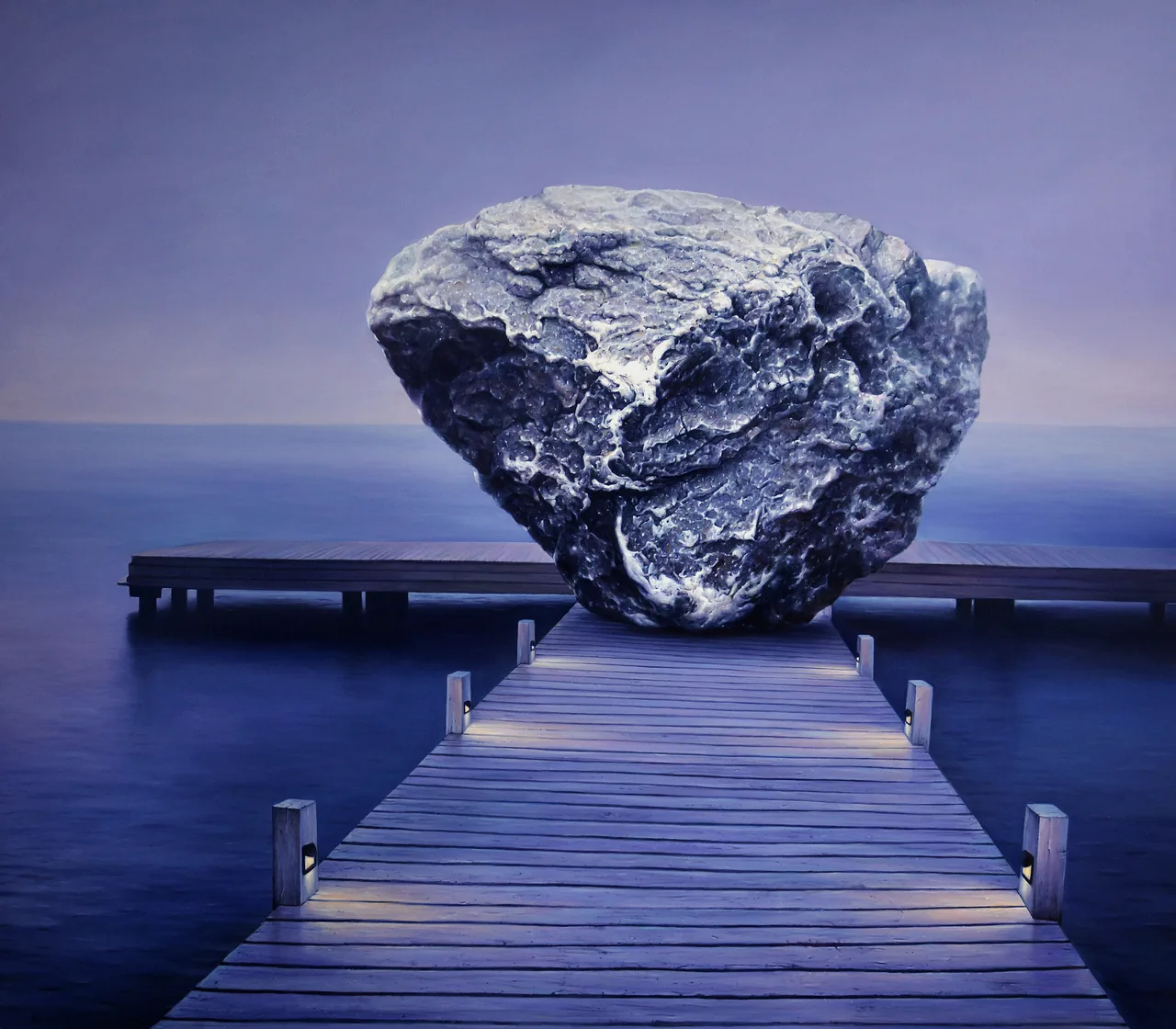
Living Stone
One huge rock fills each canvas and changes place: a shoreline, a road, a pier, a room. In Piedra viva the stone is island, fragment and above all a metaphor for the human being and his inner conflicts, painted with a metaphysical surrealism “so real that any eye can believe it”. The series was shown at the Carmen Montilla Gallery of the Office of the City Historian, Havana, in 2016.
Critical text · Toni Piñera, 2016
Traces of inner journeys: the stone
For Luis Saldaña, painting is an intense labour that takes shape from within, as he lays bare his soul through the brushstroke. Each work is a manifestation of his direct, personal approach to the pure act of painting. From the depths of the canvas there now emerge traces of his inner journey, in which the stone, today, occupies the foreground.
The sea, there is no doubt, opened its doors to the young artist. That immense blue space of dreams, experiences and stories that surrounds us as an Island, and towards which few cast their gaze these days. It is the vital backdrop of his pieces, which always breathe the landscape, as a higher or plural entity, in his enigmatic creations. For his artistic soul is made of that precious liquid gathered in the oceans. It is something that seeps into each of these windows onto art.
De mares y retornos was the title of the previous exhibition by Luis Saldaña (Güines, 1987), shown at the Centro Cultural Cinematográfico Fresa y Chocolate. The contours of the great blue, the coastlines, the seascape in its various dimensions, interwoven with objects/concepts and delineated with an innate talent for capturing it in form and tone, held the gaze of viewers—viewers left fascinated by the artistic hand of the young painter, who has not by chance carried off many prizes in all manner of competitions and art events. They were, rather, postcards of memory. Echoes from the oceans that came to be careened on the shore, laden with majesty.
There was, moreover, in those works a measure of inner mystery that the eye discovered slowly, as it settled into the depths of the paintings. Days went by, and whoever had taken that visual stroll across the skin of his canvases could not shake off the images. Without a doubt, a vital force emerges from them, like mirrors in which the sea is reflected in reality. The meticulousness of the detail clears up the unknowns.
The stones appeared. In the sea?
Time went by, and now Luis Saldaña—a graduate of the Academia de Artes Plásticas Eduardo Abela, 2006—returns with another singular exhibition that keeps the rhythm of the previous one: Piedra viva, open at the Galería Carmen Montilla on Calle Oficios, in Old Havana. Wandering through the landscape or diving into the sea…, he found the stones. And in this exhibition he stumbles over them again and again, a thousand times over, defying the saying that man never trips over the same stone—twice? In truth, his talent gives free rein to many pictorial conjectures, and returns them to us on canvas in diverse forms and tonalities, each one different. In his works (oil on canvas) we find the definitive composition that so often opens up unprecedented possibilities, full of drama. His exquisite drawing unfolds kaleidoscopically in the final precision of certain forms and features. To these qualities one may add his wise use of colour. Naturally rich, it is always exact in its fidelity to the real and, at the same time, even in canvases that might be considered monochromatic, it gives rise to a proliferating real otherness that hides behind appearances. No less central is his brushwork, his execution.
Painting, a passion
Luis Saldaña, despite his youth, is a craftsman who, whatever the subject he takes on, reaffirms—as deliberately as gesturally—that condition without which there is no painting: the passion for painting, for painting itself. In this renewing figurative work, in which drawing, light and contrast enrich the details and project them towards the effectiveness of the whole, there moves a central element that sets apart these paintings, which owe so much to the spirit of the most refined figuration and to the seductions/heartbeats of landscape. That element is light. A light that—no matter what figures, things, action or landscape it exalts—pursues an unquestionable beauty. It is the light of this Island, which is a heritage of memory.
The stones, protagonists immersed in different settings, invite us to rest our gaze on those places/backdrops that his work has travelled through over time. And it shows that pulse, dreams, sensibility, good taste—art, in a word—all fit together in that space which, by some inner magic, Saldaña gives back to us, transformed now into more than an object. Piedra viva is a step up for the artist. It moves inwards, camouflaged as landscape or as matter. It is a focal point for reflection, masking behind the stone the soul, the human being, inner strength, feats, anguish, feelings and so many other realities that give LIFE its dimensions. The stone is man.
A painting of intimacy and of the open air, his work comes as testimony to the possible and the incredible at ground level, as an inventory of a universe that must be rediscovered with as much ingenuousness as exactitude. Yet at the same time this painting, so intent on fixing what comes to pass in time, presents itself as a challenge. From that immediacy, the artist’s pieces are products of the imagination. Uncontaminated creation, in all its purity. From there, his work tends to develop in series. The images it travels through are defined by the recognition/invention of seascapes, interiors, figures, everyday objects and that splendid, tremendous landscape in which man finds or loses himself.
Toni Piñera · 2016 · On the exhibition Piedra viva, Galería Carmen Montilla, Havana · Translated from the Spanish · source
Critical text · Antonio Fernández Seoane, 2016
Piedra viva
Medium and small formats, along with five large pictorial works, carry the new aesthetic directions of Luis Alberto Saldaña, a young artist from Mayabeque who has committed himself to landscape, in which the sea—in one way or another—is never absent. But in his most recent exhibition, PIEDRA VIVA, on view until next June at the Galería Carmen Montilla of the Office of the Historian of the City of Havana, Saldaña turns his focus instead to that other natural “object”—the stone—to make it the incognito, perhaps omnipresent, protagonist of his steadfast landscape compositions, from which the human presence is excluded.
The colossal stone, then, as a stand-in for unknown inner forces—perhaps the artist’s own—provoking reflection enough within those kinds of impositions that the viewer will have to set free. PIEDRA VIVA becomes a postulate of signifieds and signifiers around this object (strikingly well conceived from a technical standpoint), denotative as such, yet connotative of those conjectures about whether or not we know what we are facing, all the more so when the stones might “rest”, not to say “inhabit”, the space of this elegant staging: a seashore, inside a house, in the middle of a road, waiting on a quay… A verbal discourse that will have to be uncovered in that other spectacle of artistic good taste that PIEDRA VIVA achieves, an accumulation of reflections that might lie hidden behind the enormous bulk of this protagonist in the large formats of these landscapes which, I insist, spring from the shrewd idea and bold artistic spirit of Luis Alberto Saldaña: an exhibition that, without a doubt, marks a step up in his career as a painter…
Antonio Fernández Seoane · 2016 · Text for the Agenda Cultural of CMBF, Radio Musical Nacional · Translated from the Spanish · source
Oil on canvas · 32 × 38 cm each (12.6 × 15 in each)
Oil on canvas · 130 × 150 cm (51 × 59 in)
Oil on canvas · 130 × 150 cm (51 × 59 in)
Oil on canvas · 125 × 200 cm (49 × 79 in)
Oil on canvas · 110 × 125 cm (43 × 49 in)
Oil on canvas · 130 × 170 cm (51 × 67 in)
Oil on canvas · 32 × 38 cm (12.6 × 15 in)
Oil on canvas · 32 × 38 cm (12.6 × 15 in)
Oil on canvas · 32 × 38 cm (12.6 × 15 in)
Oil on canvas · 32 × 38 cm (12.6 × 15 in)